From Standard SUV to Overland Build: Cayenne, Touareg & Q7
One platform family. Three serious starting points.
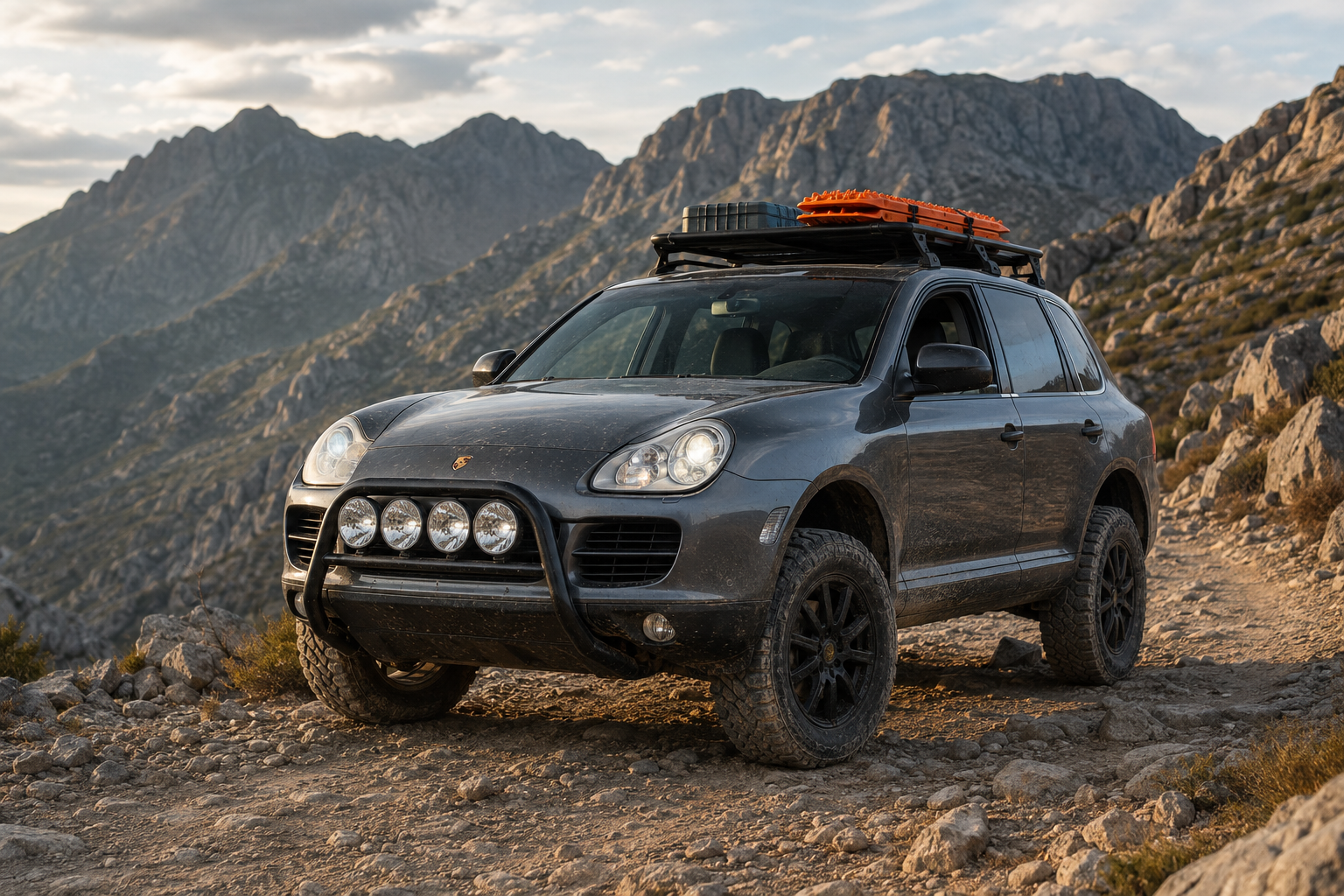
The Porsche Cayenne 955/957, Volkswagen Touareg 7L and Audi Q7 4L share important engineering roots. That makes them unusually interesting foundations for touring, overland travel and technical off-road builds. But a good result comes from treating the vehicle as one complete system: suspension, tyres, protection, payload and recovery equipment must work together.
These vehicles combine strong drivetrains, permanent four-wheel drive and long-distance comfort with a platform that can be adapted far beyond standard road use. Shared architecture can also create useful development knowledge across the three models. It does not mean that every component is automatically interchangeable. Model, year, engine, suspension type and local regulations must always be checked before ordering or fitting parts.
1. Define the mission before choosing parts
Start with the journeys the vehicle must handle. A daily-driven Cayenne with occasional forest-road use needs a different setup from a fully loaded Touareg used for remote travel. An Audi Q7 prepared for long motorway stages and campsite access has different priorities again.
Write down the expected payload, tyre size, terrain, trip duration and recovery needs. This determines the right balance between ground clearance, comfort, durability and weight. It also prevents one modification from creating a problem somewhere else.
2. Build the suspension as a system
A suspension lift can improve ground clearance and create room for larger tyres, but lift height alone is not the goal. The useful result is controlled wheel travel, correct geometry and predictable behaviour when the vehicle is loaded.
Air-suspension and steel-spring vehicles require different decisions. Component condition, alignment range, driveshaft and control-arm angles, brake-line clearance and shock travel all deserve attention. After installation, the vehicle should be aligned and all critical fasteners checked again after the first kilometres of use.
3. Match wheels, tyres and offset
Tyres often deliver the biggest practical improvement in traction and resilience. The correct size must still clear the body, suspension and liner through full steering lock and suspension compression. Wheel width and offset influence more than appearance: they affect clearance, scrub radius, bearing load and how much the tyre projects beyond the bodywork.
Always test the complete combination on the specific vehicle. A setup that works on one Cayenne, Touareg or Q7 may need changes on another because of brakes, trim, suspension or production-year differences.
4. Protect the parts that stop a journey
Underbody protection should focus on vulnerable and expensive components: engine, transmission, transfer case, fuel system and exposed cooling parts. Bullbars, rock sliders and recovery points should be selected for their structure and mounting method—not only for their visual impact.
Recovery points must be rated, accessible and connected to a suitable part of the vehicle structure. The same principle applies to towing and winching equipment. If a component has a safety-critical role, professional installation and inspection are worth prioritising.
5. Keep storage low and weight under control
Roof racks, awnings, boxes and tents can transform how the vehicle works at camp, but roof weight raises the centre of gravity. Heavy recovery tools, water and spares are usually better carried as low and as centrally as possible. Check both the vehicle payload and the permitted roof load, including the rack itself.
6. Add lighting, power and recovery last
Auxiliary lighting and electrical accessories should be planned around actual use. Clean cable routing, correct fusing, relays, weather-resistant connections and accessible isolation matter more than the number of lamps. A basic recovery kit, tyre-repair equipment, compressor and safe lifting solution will often add more capability than another cosmetic upgrade.
Development insight from MBD4x4
MBD4x4’s development story began with modifying a vehicle in practice: lift spacers led to larger wheels and the need for a different offset, which in turn created the next engineering questions. That step-by-step approach reflects how a coherent build develops in the real world. Their range spans lift kits, protection, roof systems, lighting, brackets and other off-road equipment.
TerraForge4x4 uses authorised MBD4x4 material as a technical and visual source while adding platform-specific context, installation guidance and real-world build experience. Explore the manufacturer at MBD4x4.
The TerraForge4x4 approach
Our goal is to document what works on the Cayenne 955/957, Touareg 7L and Audi Q7 4L—and to be equally clear about what still needs verification. Fitment notes, installation details and lessons from real use turn individual products into a dependable vehicle.
Before modifying any road vehicle, confirm local approval, inspection and insurance requirements. Use the manufacturer’s current instructions and torque specifications, and have safety-critical work checked by a qualified professional.